
30 Jan 2026
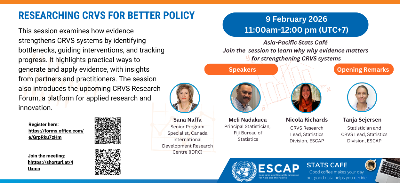
Asia-Pacific Stats Café Series: Researching CRVS for Better Policy
TAGS

ESCAP is hosting a new session of its Asia‑Pacific Stats Café Series on 9 February 2026, focusing on the central role of evidence in strengthening civil registration and vital statistics (CRVS) systems. The session will highlight how a solid evidence base enables countries to diagnose bottlenecks, design targeted interventions, and monitor the performance of their systems. The discussion will feature practical approaches for generating and applying evidence to inform CRVS reforms, drawing on insights from development partners and practitioners who have undertaken evidence‑driven improvements in their national contexts. The upcoming CRVS Research Forum will also be presented.


Date: Monday, 9 February 2026  

Time: 11.00 - 12:00 a.m., Bangkok time (UTC+7)

Venue: MS Teams

Event page: Asia-Pacific Stats Café Series
More News

22 January 2021

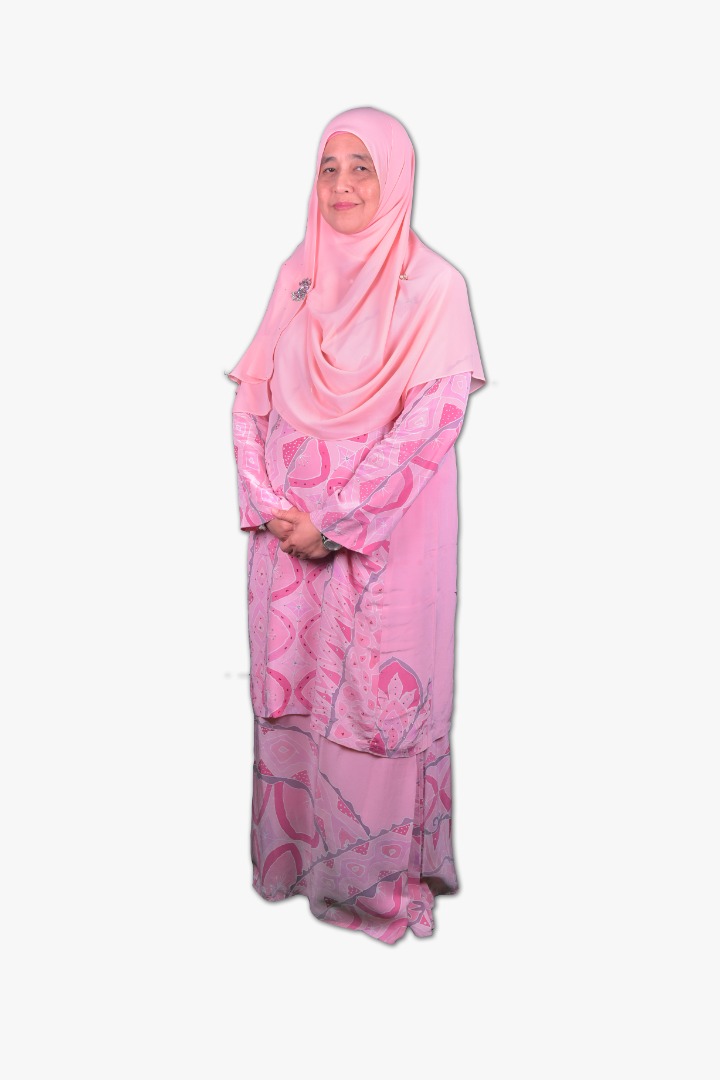
Newsletter: CRVS Insight January 2021 CRVS Champion: Ms. Nazaria Baharudin Each month, our…

14 December 2020

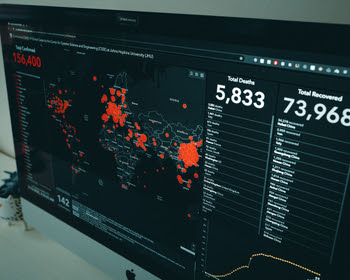
(Newsletter: CRVS Insight December 2020) The COVID-19 pandemic is challenging country mortality…

14 December 2020

(Newsletter: CRVS Insight December 2020) In Iran, in November of 2019, the first Iranian identity…

14 December 2020

(Newsletter: CRVS Insight December 2020) Each month, our community newsletter puts a spotlight on…

14 December 2020

(Newsletter: CRVS Insight December 2020) Regional Steering Group members, Ms. Kamni Naidu (Fiji),…

24 November 2020

(Newsletter: CRVS Insight November (2) 2020) In preparation for the Second Ministerial Conference…

24 November 2020

(Newsletter: CRVS Insight November (2) 2020) Following a number of years of consultations and…

24 November 2020

(Newsletter: CRVS Insight November (2) 2020) In a major step toward universal registration, the…

24 November 2020

(Newsletter: CRVS Insight November (2) 2020) The ESCAP CRVS team is proud to announce the launch…

03 November 2020

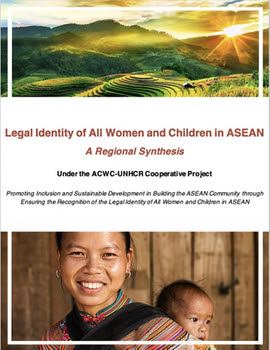
(Newsletter: CRVS Insight November 2020) Women and children are often vulnerable to being left…