
28 Nov 2025
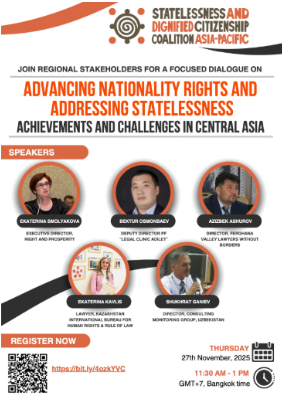
Advancing Nationality Rights and Addressing Statelessness: Achievements and Challenges in Central Asia
TAGS

The Statelessness and Dignified Citizenship Coalition – Asia Pacific (SDCC-AP) is organising their quarterly webinar, which will spotlight Central Asia’s progress in addressing statelessness.


Central Asian countries have achieved notable success in addressing statelessness, offering valuable lessons for the wider Asia-Pacific region, where legal gaps, implementation challenges, cross-border mobility, and gender-based discrimination continue to perpetuate statelessness.


As part of SDCC-AP’s Quarterly Webinar Series, the event aims to strengthen cross-regional solidarity, share effective strategies, and advance collective advocacy to ensure dignified citizenship and full nationality rights for all.


Date: Thursday, 27 November 2025

Time: 9:30 AM – 11:10 AM (Tashkent, GMT+5)

Venue: Zoom

Register: Link

 

More News

10 September 2020

(Newsletter: CRVS Insight September 2020) The new online platform hosts a diverse listing of…

10 September 2020

(Newsletter: CRVS Insight September 2020) UNICEF Kazakhstan is looking for an expert to support…

10 September 2020

(Newsletter: CRVS Insight September 2020) The Global Partnership for Sustainable Development Data…

20 August 2020

(Newsletter: CRVS Insight August 2020) The Centre of Excellence for Civil Registration and Vital…

20 August 2020

(Newsletter: CRVS Insight August 2020) The World Bank has announced that another round of the…

20 August 2020

(Newsletter: CRVS Insight August 2020) As part of its ongoing support for countries improving the…

20 August 2020

(Newsletter: CRVS Insight August 2020) CRVS systems play a significant role for all individuals by…

20 August 2020

(Newsletter: CRVS Insight August 2020) The seventh session of the ESCAP Committee on Statistics…

18 August 2020

To inform the discussions around CRVS at the seventh session of the ESCAP Committee on Statistics,…

20 July 2020

(Newsletter: CRVS Insight July 2020) Based on data from 174 countries, the UNICEF report, Birth…